Showing posts with label Tools. Show all posts

Sunday, March 21, 2010

Know the tools of the poet's craft: Printer Edition

Keith Wilson, one of my favorite poet-bloggers has a great post on buying a printer. 

"It goes without saying that any venture you're going to invest a considerable amount of money in deserves the same kind of special attention you give your car, or your home. But I never hear writers talk about these kinds of things; it's always about art, or the struggle, or even the business (that is, trying to land gigs or teaching jobs), but rarely the more technical side.

I'm talking about the things that can save us a ton of money, like management of resources on road trips, or filing for taxes as an artist, or in this case, getting a printer.

A while back, when I had some cash burning a hole in my pocket, I made the somewhat drastic decision to buy a new printer. Don't let this precursor dissuade you from doing the same, because it turned out to be an excellent decision, but I'm not going to act as if a ton of planning went into this; I had an old printer I hated, and I wanted a new one.

But my inability to look before I leaped is to your benefit. First things first.

Wednesday, March 17, 2010

EasyPrompter - the best free online teleprompter.


You'll be hearing way more audio versions of my poems. (Not that you asked for them). I found Easy Prompter. Type your poem and it will scroll in a large font across your screen. It's an easy tool to practice recording and reciting at the same time.

It can also work as an editing tool for lines and enjambments. Reading your poem aloud, it's easier to hear the caesuras. Reading and hearing the caesuras in real time, makes the issues with line endings more apparent. Or maybe you're like me, and you like to mix technology with poetry.

Try out Easy Prompter. It's free. EasyPrompter - the best free online teleprompter.

Evie Shockley, Top Ten Reasons Why It’s Okay That There Are “Too Many Poets”


Because more poets means more points of view, more experiences, more lexicons, more aesthetic choicesa wider range of voices, by any measure—will be available to the poetry reader. And, likewise, more and different readers of poetry will be called forth. If not inevitably, very probably.


Read more at a b o u t a w o r d 
 

Thursday, March 11, 2010

Make Time to Po-em

In My Craft or Sullen Art (Dylan Thomas) - Kni...Image by chrisjohnbeckett via Flickr

Let’s face it. There are few full time poets in the world.  A full time poet is a person who can live off of what they get paid for writing and sharing their poems.  Most poets have another job that pays the bills. This means we’re in a constant war for time to invest in our true gift. This leaves less time to
  • write poems
  • edit poems
  • compile poems
  • record poems
  • recite poems
  • publish poems

And last not not least- SELL poems. These are our essential tasks as poets. So what aren’t you making time for?

Thursday, November 19, 2009

Go On A Silence Retreat

I would use all of Oprah’s billions to purchase unlimited silence.  Silence and solitude are the playground for my creativity.  There can be no distraction.

Remember solitude  on a day long silence retreat.  Here’s the trick, it must be a full day. If you have a partner or children, send them away the night before, and don’t let them come back until the day after. (This makes Saturday the optimal day for silence retreats).

You want to wake up alone with yourself, with silence. 

The Rules

Do not communicate or interact with a human being. This includes:

  • In-Person Conversations
  • Phone Calls (Turn the Ringers Off)
  • Text Messages
  • Emails & Fax
  • Instant Messengers, Twitter
  • Blog Posts &  Comments

Next, do not communicate with media:

  • Television (DVD Player included)
  • Computer games
  • Internet
  • Music with words (Instrumentals, Classical, Jazz allowed)
  • Book (yes book lovers, books)

silence

The Night Before

Write a list of specific actions you want to complete. It may seem like underachievement, but focus on one action for only one poem. For the following example, I’ll use a fictional poem called Tread in Silence.

  • Finish writing Tread in Silence
  • Revise Tread in Silence
  • Record  Tread in Silence
  • Add sounds to  Tread in Silence.
  • Memorize Tread in Silence.
  • Rehearse performing Tread in Silence.

While it may be tempting to create a marathon by writing X number of poems, creating a submission package or compiling a chapbook, small actions work well.  You may be surprised at how long it  takes you to revise a poem or how quickly you can memorize one. This time is about self-discovery. By this practice, you’re learning what you need to delve into your writing process.

The Day

Wake up in solitude, with yourself and silence.  Most books tell us to wake up and write.  I prefer to take a shower, put on clothes, pray and eat breakfast. This can take me up to two hours. It’s ok if I give myself that time because I know it’s me preparing for the work.  I take out my list and begin working on whatever task I prepared for myself.  I break for lunch. Then I come back to the words, exercise, then dinner.  After dinner,  create a quick to do list, giving yourself 3 items that you want to work on during your next writing time.  Again, make sure they are specific actions.

Phase in media by reading a book. Read it until you fall asleep .  Of course parents should always check in to see how their children are doing.  Feel free to talk with your partner  but don’t tell them  exactly what you were working on, keep it private.  Sometimes we need to keep our creative parts to ourselves. 

The Day After

Welcome your partner and family.  Go out to lunch with a friend.  Just reintegrate yourself back into the “noisy world.”

I’ve been taking silence retreats for 14 years.  Most times, they last for only a couple of hours.  Still, there are other times that last for days.  These are always my most productive writing periods.

If you have a little extra cash ($50), go to a local bed and breakfast or motel. You can usually find great deals on Tuesdays.  If you call ahead, you can even schedule a stay like an extended work day (checking in at 9 and leaving at 9).

Forgive Yourself

Even if you succumb to watching movies all day and don’t get any work done, you’ve still taken a mini vacation from communicating with others. Schedule another silent retreat for the following month.

If writers write, then poets poem. Use your solitude and silence to poem.

Thursday, November 5, 2009

10 Items You Need to Hustle Your Poetry

Image via WikipediaBrockhaus Konversations-Lexicon, 1902
Some of us ok me work at perfecting our craft for years. We fantasize about MFA poetry workshops and dream of all the silence and solitude to write. Our thesis will get picked up by a university press and our life as a poet begins.

There is a shorter route. If you’ve written 20 poems, there is no reason not to organize and share your work.   What distinguishes modern poets from our literary ancestors is our access to communication media.  With all the avenues available to us today, it can become overwhelming to figure out how to distribute work. Below are a few items that can help your hustle.

  • a bookmark
  • a broadside
  • a book  (preferably with 6  poems accepted in literary journals/magazines)
  • an album
  • an audio interview
  • a video of a live reading, recitation, or performance
  • photographs
  • newspaper, magazine, or blog feature
  • website (with upcoming events)
  • press kit
I debate friends saying Pulitzer Prize winner Natasha Tretheway’s imagepoetry may  not go well in the spoken word/slam/open mic scene.  She wouldn’t memorize her poems. She doesn’t read with a cadence. She probably wouldn’t even have a book or cd to sell afterward. Yet she won the top prize in literature.

On the other hand, I have witnessed people with hustle sell unfinished, unedited, unpoetry, by sheer force of personality.  There’s something to be learned from both.  Polished pieces sell. Marketing works. Surely those who cherish the written word can offer a polished product with a little hustle. 


 Can you think of another item to hustle your poetry?

Thursday, October 29, 2009

Publication: Calyx Press

CALYX exists to nurture women’s creativity by publishing fine literature and art by women. CALYX is committed to:

  • introducing a wide audience to high quality literature and art by women
  • providing a forum for diversity and underrepresented writers and viewpoints
  • discovering and publishing emerging and developing writers
  • preserving publications for future audiences 

[from website]

image

Guidelines “excellently crafted poetry that also has excellent content”
lyric and free verse
up to 6 poems
Reading Time October 1 – December 31
Response Time 9 months
Payment Contributor’s Copy
Sample Copy $10.00

More on Calyx Press guidelines.

Thursday, October 22, 2009

Is Your Haiku a Senryu?

A visual comparison of haiku and senryu.


haiku vs senryu

I know we tend to remix things in America. For instance, we add titles to our haikus and rarely are they statements with commentary. Still, I offer this post in the name of Basho. 

Please consider, that a short poem that is not about nature or the changing of  seasons is not a haiku, it is a senryu in hiding.  All that time you thought you were writing haiku, it was probably senryu.  Now that you know, add it to your repertoire.


Add your senryu below

Thursday, October 15, 2009

Have You Published A Broadside?

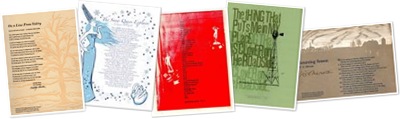
A broadside is a great way to introduce your poetry.   Most broadsides are printed in the standard 8 1/2 by 11 size on a heavier card stock.  The average broadside prints at about 100 copies. 

Select a poem that works as an anthem (or even an anti-anthem). This poem has a strong opinion and shows your craft but is accessible to the average reader.  Then choose an image associated with the poem.  If you don’t want to border on ekphrasis, feel free to choose a simple design.  In a word processor, embed the image or design as a background.

After you add the poem to the layout, decide on other style elements.  For instance, you may want to place the title in block letters along the left hand side of the paper. Use the style elements to add your personality. Some poets hand sign each broadside. 

After you’re finished with design, add your contact information in small print at the bottom of the page.  Make sure you direct readers to your website and mention a recent entry in a print publication or book.

Finally, share your poems with others. You will be tempted to print 100 copies, but instead choose to print 10 to 25 in your first edition. You don’t want to get overwhelmed.

Leave the broadsides in places where people read publicly: libraries, cafes, delis, galleries, park benches, hairstylists, even doctor/dentist waiting rooms.  Here’s the challenge, offer these broadsides to people who are not family, friends or coworkers.  Spend a weekend sharing your work with strangers. Take along a spouse or friend if you need a bit of courage. 

If you don’t have the time to record your own cd, or publish a chapbook, why not hand out a broadside at your next reading? Even if it’s a local open mic,  it introduces you to an audience.  If you do have a cd and book, try this:

“I know you may not be able to afford my book or cd, but please walk away with a free broadside. We’ve had such a wonderful time tonight that I don’t want money to get in the way. I’ll be handing out free broadsides and a bit of small chat afterwards. Stop by.” 

You’re opening up yourself as an artist to extend the emotional connection you created in the poem’s presentation.  Those who really enjoyed your poem will stop by to pick up the broadside. You’ve just expanded your readership! 

A broadside is a poet’s literary equivalent to a musician’s album single.  A broadside should get people interested in more of your writing.  To go one step further, have a downloadable pdf, audio version and perhaps a  video of reading or performance of that poem on your website.  It’s an instant hook for the reader who wants to extend that relationship with your writing. The goal is to create unique relationships with readers who will want more. With one poem you can generate consistent a readership.


Thursday, October 8, 2009

The Importance of Table of Contents

298 table of contents gravures 2
Image by blacque_jacques via Flickr
In the beginning of  Writing Down the Bones, Natalie Goldberg challenges readers to find writing tools.   The  right pen and notebook can free a writer. It took me years to discover that I prefer an 8 1/2 by 11 inch  spirally bound sketcher’s pad without lines. I didn’t realize that lines on paper made my words feel constricted.  It radically changed my writing.  I wrote faster, deft lines.   For those poets who write in notebooks, this post is for you.

I came across a fabulous tip.  Do not write in the first few pages of your notebook.  When you’ve completed the notebook, add page numbers.  Then add a Table of Contents to the front pages. List your poems and their page numbers.  If you want to be ambitious,  add a category or theme.  Now you’ll be able to see the thematic connections in your poems at a glance. When you collect the poems together for a submission set, chapbook or a cd, you already have a starting point to organize your work. 

Isn’t each complete notebook, a collection itself? How delicate and clean a Table of Contents can be. It’s a map to an entire collection.  Honor National Poetry Day in the Uk, take a completed notebook and add a table of contents.

Thursday, October 1, 2009

Organizing Tool for Poetry Sets

Have trouble organizing your poetry? I have the same problem. Since the poetry establishment prefers poems in sets of 5, I’m embarking on categorizing my poems into these numbered sets.  I added this guide to help you.
 Categories for Organizing Poetry
Also, if you want another visual tool to show your poems’ relationships to each other, check out the template below.

Poetry Set


Read my How To Organize Poetry article on Ehow.com for a detailed guide to compiling your poetry set. 


 How will these tools help you organize your poetry?

Friday, September 18, 2009

22 Things I've Noticed in the Poetry Blogosphere


1. There are unique well-crafted poems that deserve to be uploaded  in an e-book & mp3 this weekend.

2. A collective or writing workshops are behind the quietest bloggers.

3. Even MFA graduates struggle with how to promote their poetry books.

4. Some poets are actually speakers not poets.

5. The Japanese should send a PSA about the form parameters of the haiku. 

6. Become an expert on one form.

7. Many poets are reluctant to add  voice recordings but will reveal their full name & address online.

8. Some poets think creating a movement around their poetry is the best way to promote their work.

9. Celibritizing  unpublished poets can be encouraging or narcissitic.

10. Modern published poets largely go unread, unheard, and unkown.


11. Some poets do not own 1 poetry book (not because they read them at the library frugalistas/os).

12. Some spoken word artists do not know about the Black Arts Movement, Beat Movement, Harlem Renaissance or New Negro Movement, but lay ancestral claim to being a griot.

13. Some view the identity of a poet as akin to being a rockstar.

14. There are great book reviews that have a direct link to purchasing the book!

15. Content in between poems adds a bit of personality to the blog.

16. A poem per week over a poem per day may be more sustainable over time.

17. Submitters, question, as do I, why journals who accept electronic submission take months to reply.

18. Some poets are actually journalers, not poets.

19. Blogs are a great way to organize hobbies and interests online.

20. Some poets view comments or blog post features as attacks or attention-stealers.

21. Poet bloggers can become the top tier of true influencers, not direct marketers, online.
 

Feel free to add your own #22 below.


Related Posts with Thumbnails